
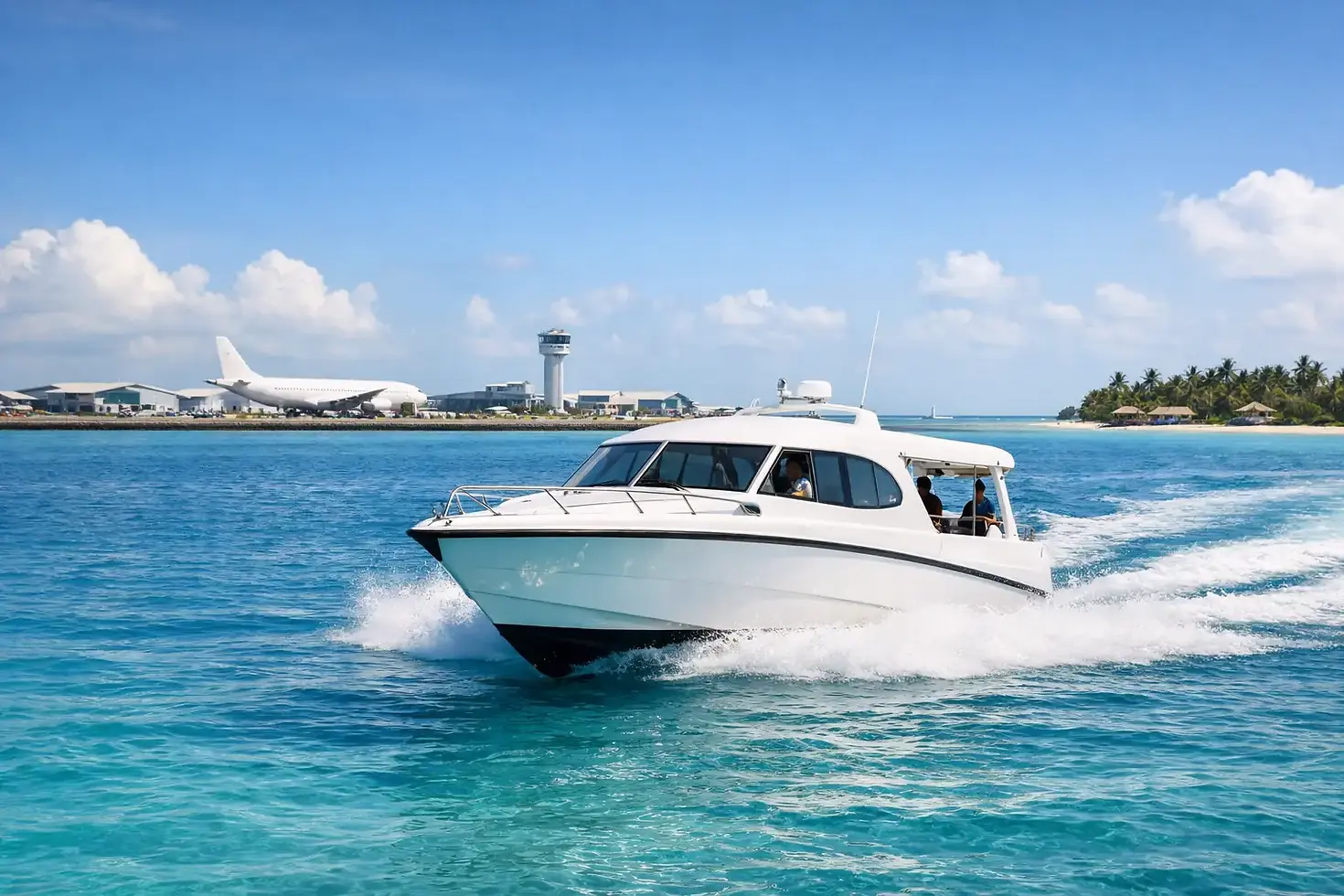
Speedboat Transfer from Maldives Airport

A speedboat transfer from Maldives airport is often the first moment when an arrival becomes a Maldivian holiday or a carefully managed business itinerary. After landing at Velana International Airport, passengers may be only minutes from their resort jetty - or they may need to connect to a domestic flight or seaplane instead. Getting that distinction right before wheels-down matters, particularly for private aviation movements, late arrivals, families, substantial baggage and guests who expect discreet, well-paced service.
For operators and travel representatives, the transfer is not simply a hospitality add-on. It is a time-sensitive movement involving flight status, immigration clearance, baggage release, marina access, resort schedules, weather conditions and passenger welfare. A properly coordinated arrival keeps the handover between aircraft, terminal and boat calm, clear and accountable.
When a speedboat transfer from Maldives airport is the right choice
Velana International Airport, commonly referred to as Malé airport, sits on Hulhulé Island beside the capital. Its proximity to several atolls makes speedboat travel practical for a wide range of resorts, private islands and accommodation properties in the North Malé Atoll, South Malé Atoll and nearby areas.
The deciding factor is water distance, not simply the category of hotel. A speedboat is usually suitable where the crossing can be completed comfortably within a reasonable period, often between 15 minutes and around 90 minutes depending on the property and sea state. Resorts farther afield typically require a seaplane or domestic-aircraft connection followed by a short boat journey. In some cases, a domestic flight offers the more reliable option for guests travelling long distances across the archipelago, particularly where open-water conditions may affect a lengthy boat passage.
A speedboat transfer Maldives airport service should therefore be confirmed against the final destination, expected arrival time and number of travellers. Never assume that a resort advertised as close to Malé is reachable by boat at every hour or under every condition. Some properties operate set boat departures, while others can arrange a private vessel subject to availability.
The arrival sequence: aircraft to marina
For commercial guests, the transfer process begins after immigration, baggage collection and customs formalities. For private-jet passengers, a ground handler can coordinate arrival supervision, passenger assistance, baggage handling and the transition from the aircraft environment to the appropriate landside or waterside meeting point.
The order of events is straightforward, but it needs active management. The receiving team confirms the flight’s actual arrival time, monitors any delay, meets passengers at the agreed point and ensures that baggage is identified before the party proceeds to the jetty. Resort representatives or transfer coordinators then take charge of boarding documentation, luggage loading and vessel departure.
Private travellers often value an unhurried experience, yet speed remains relevant at the airport. A late-arriving aircraft can miss a scheduled resort boat, and an early arrival can leave guests waiting if the boat has been timed only against the published schedule. Flight tracking and direct communication between the aircraft operator, handling agent and resort transfer desk help avoid both outcomes.
For a VIP movement, the experience should also account for the practical details that affect comfort: shade while waiting, refreshment, support for children or elderly guests, careful handling of delicate luggage and a clear explanation of the onward journey. Discretion is particularly important where high-profile passengers, executive teams or medical travellers are involved.
Arrival information to provide in advance
Transfer coordination works best when the local team receives the aircraft registration or commercial flight number, scheduled and estimated landing times, passenger names, party size, baggage count and destination resort. It is also useful to declare oversized or unusual items in advance, such as golf bags, surf equipment, dive equipment, mobility aids or large instrument cases.
For general aviation flights, the aircraft’s parking position, handling arrangements, customs requirements and anticipated passenger release time can influence the transfer plan. The boat operator should not be left guessing whether guests will emerge from a commercial-arrivals flow or be escorted through a private aviation handling process.
Timings are more than the crossing time
A common planning error is to calculate only the journey on water. The total transfer period also includes disembarkation, terminal formalities, baggage delivery, the walk or vehicle movement to the marina, boarding and any wait for other resort guests. On a smooth daytime arrival, this can be efficient. During busy periods or disrupted operations, it can take longer than expected.
The final boat departure of the day deserves particular attention. Many resorts can arrange evening speedboats, but not all operate overnight services, and procedures vary. If an international or private flight is due close to the resort’s last scheduled departure, the travel plan should include a contingency. That may mean arranging a private boat, securing an overnight room near the airport, or choosing an alternative air connection where appropriate.
Departure day needs equal care. Guests should leave the resort with sufficient allowance for the boat ride, check-in requirements, security procedures and any private-flight handling steps. Sea conditions, early-morning darkness and resort boat timetables can affect the recommended pick-up time. A flight crew or trip support team should confirm the plan against the airport’s operating requirements rather than relying on a generic hotel instruction.
Weather, safety and comfort at sea
The Maldives is defined by water, but the sea is not identical every day. Wind, swell, rain and visibility can change the character of a crossing quickly, especially outside sheltered channels. During seasonal weather patterns, a route that is gentle in the morning may be more demanding later in the day.
A premium transfer plan puts safety before timetable pressure. The vessel should be suitable for the route and passenger load, operated by an experienced crew, equipped with appropriate safety gear and maintained to required standards. Passengers should receive clear boarding guidance, and lifejackets should be readily available and correctly sized, including for children.
Comfort deserves practical consideration too. Guests prone to seasickness may benefit from choosing a seat with fresh air and a clear view of the horizon, avoiding a heavy meal immediately before departure and carrying suitable medication if advised by their clinician. A private boat may offer greater flexibility and privacy, but it is not automatically better in difficult conditions. The most suitable option depends on vessel design, route, weather and the needs of the group.
For air-ambulance or medically supported travel, transfers require an additional level of planning. Mobility requirements, stretcher compatibility, clinical equipment, escort staffing and receiving-resort access must be assessed before travel. A bed-to-bed movement depends on every handover being planned, not improvised at the jetty.
Scheduled resort boats versus private speedboats
Scheduled resort transfers are often efficient and cost-effective, particularly for standard leisure arrivals. They may involve a short wait for other guests or operate at fixed intervals. This is entirely suitable when flight timings align and passengers are comfortable sharing the journey.
A private speedboat offers control over departure timing, privacy and the ability to tailor the service for families, executives or groups with significant luggage. It can also be useful for travellers arriving by private jet, where the itinerary may change at short notice. However, private availability can be limited during peak periods, and a private charter should be confirmed early rather than treated as a last-minute assumption.
The appropriate choice depends on the guest profile and operational exposure. A family arriving mid-afternoon may be well served by a scheduled resort boat. A principal travelling after a delayed business-aviation arrival may require a private arrangement or a carefully selected overnight plan. The objective is not to make every journey private, but to ensure the selected service matches the real itinerary.
One coordinated arrival standard
The strongest airport-to-resort experiences are built around one informed point of coordination. That partner needs visibility of the flight, passenger requirements, resort confirmation and transfer status, with authority to resolve changes as they occur. This is especially valuable in the Maldives, where aviation operations and island logistics are closely linked but managed by different parties.
Brook Aero coordinates aviation ground handling and destination logistics with the operational discipline required for private, commercial and medical movements. For passengers, the benefit is a considered welcome and a clear onward plan. For crews, dispatchers and aircraft managers, it is the assurance that the last mile from the airport has been planned with the same attention as the flight itself.
Before confirming any Malé arrival, ask a simple question: where will each passenger be, with their baggage, if the aircraft lands early, late or after the final scheduled boat? A transfer plan that answers that question clearly gives everyone a better start to their stay.


Comments